Summarized example
Here we summarize the nine previous steps with the simple Java example executable we have used through the documentation.
Our component takes as input a text file and produces a text file as a result. It has one parameter 'p' which is used by the JAR executable. This is what the component folder looks like after we execute the first MIC command:
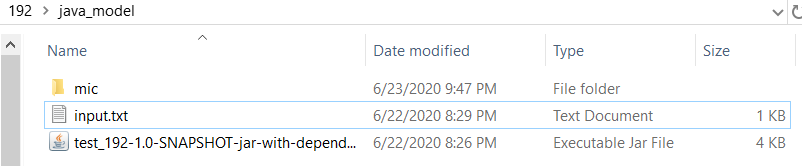
The sequence of commands required for encapsulating the model are:
- Start:
mic pkg start - Trace the execution command:
mic pkg trace java -jar test_192-1.0-SNAPSHOT-jar-with-dependencies.jar -i input.txt -p 1500 -o output.txt - Expose the 'p' parameter with default value 1350:
mic pkg parameters -f mic/mic.yaml -n p -v 1350. - --Configuration step not necessary because model does not have configuration files--
- Select inputs to expose:
mic pkg inputs - Select outputs to expose:
mic pkg outputs - Create wrapper:
mic pkg wrapper. Edit therunfile to indicate where the parameterpneeds to be passed on, by replacing it in the invocation command. - Run wrapper and verify results:
mic pkg run. Once you are done, exit the MIC environment: Typeexit - Upload:
mic pkg upload
Done!